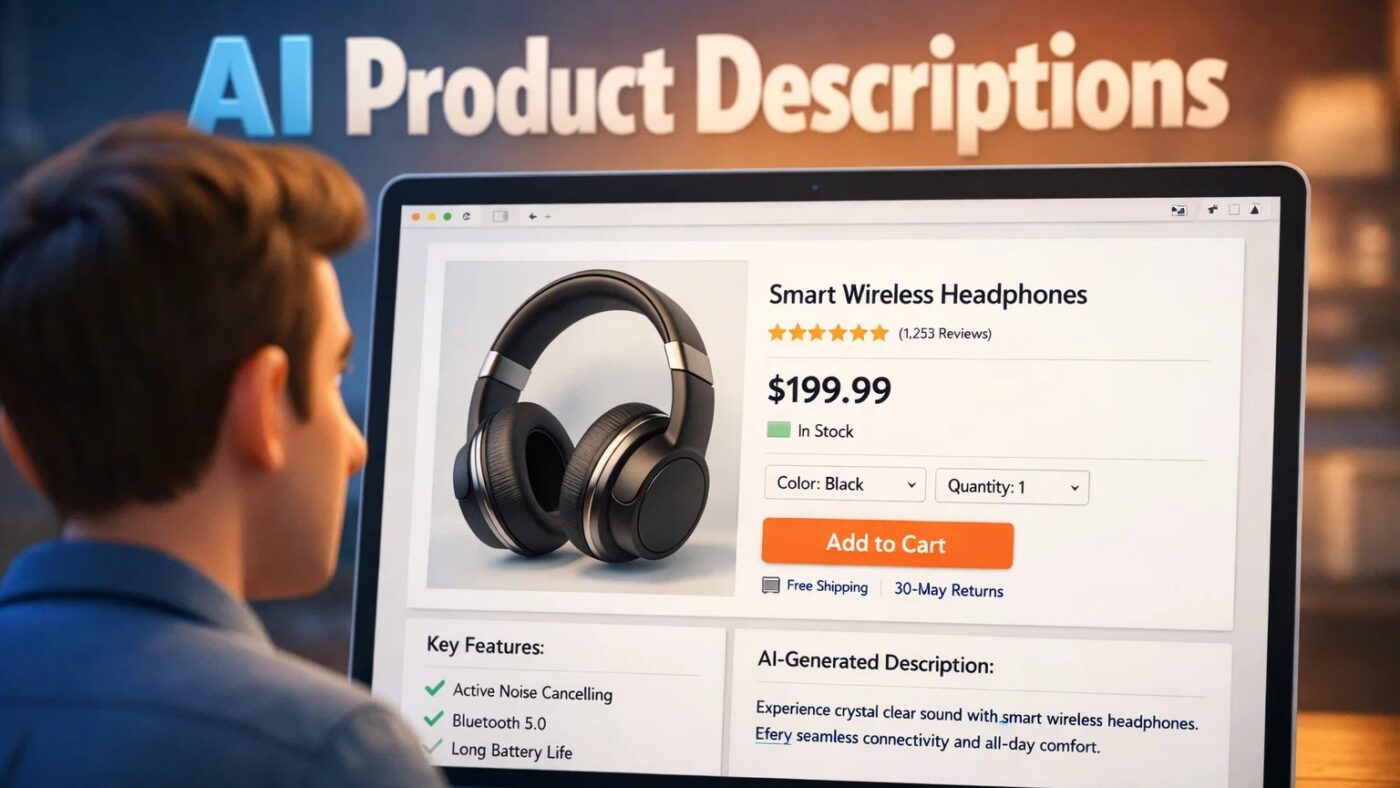
eCommerce AI Product Descriptions: Good or Bad?
In 2026, the question isn’t whether you should use AI for your eCommerce store, it’s whether you’re using it well enough to keep your customers from bouncing.
We’ve moved past the era of “robot-speak” descriptions, but as AI becomes the backbone of online retail, a new debate has surfaced: Is automated content a conversion goldmine or a brand-killer.
Let’s break down the reality of AI product descriptions today.
The Good: Why AI is Winning the Race

If you’re managing a catalog of 5,000+ SKUs, manual copywriting isn’t just slow; it’s an operational bottleneck.
AI has stepped in to handle the heavy lifting with some serious perks:
- Speed at Scale: What used to take a team of writers months now takes minutes. You can launch entire seasonal collections overnight.
- Built-in SEO: Modern AI doesn’t just write for humans; it writes for algorithms. It can weave in high-intent keywords and structured data that help your products show up in both Google searches and AI-driven shopping agents.
- Global Expansion: Translation is no longer a separate, expensive step. The best AI tools now handle multilingual SEO and local nuances simultaneously, allowing you to “go global” without a massive localization budget.
- Consistency: AI ensures that your brand voice remains identical across every single product page, whether it’s a high-ticket item or a tiny accessory.
The Bad: Where AI Can Trip You Up

It’s not all sunshine and high conversion rates. If you hit “generate” and “publish” without a second thought, you might run into these common 2026 pitfalls:
- The “AI Slop” Factor: Consumers are getting smarter. If your descriptions feel generic, repetitive, or lack “soul,” shoppers lose trust. Purely mechanical descriptions can feel like “AI slop” that lacks the persuasive punch of human emotion.
- The Hallucination Headache: AI can occasionally get “creative” with facts, claiming a polyester shirt is “breathable silk” or adding features that don’t exist. Without a quality-control layer, these errors lead to high return rates and angry reviews.
- The Trust Gap: A recent study showed that while 56% of shoppers use AI for research, 89% still feel a “lingering concern” about accuracy. If a description feels fake, the customer assumes the product is, too.
The Verdict: It’s All About the “Inspector”

The consensus in 2026? AI descriptions are good, but only if they are monitored.
The most successful eCommerce brands use a “Human-in-the-loop” or an “AI-verifying-AI” approach.
By using multiple LLMs to cross-reference facts and a dedicated quality layer to “inspect” the output, you get the speed of a machine with the accuracy of a pro.
Scale Smarter with Ovesio
If you’re ready to scale your store without the “AI slop” or the massive copywriting bills, it’s time to meet Ovesio.
Ovesio is a high-performance eCommerce intelligence platform designed to handle the heavy lifting for you.
It doesn’t just “write descriptions”; it uses a unique AI Inspector to cross-reference multiple AI models (like Gemini, Claude, and GPT-4) to ensure your content is accurate, persuasive, and 95% similar to human-level quality.
With Ovesio, you can:
- Generate high-converting product descriptions in seconds.
- Translate your entire store into 30+ languages with automated multilingual SEO.
- Predict stockouts and manage inventory with AI-powered forecasting.
Stop wasting money on slow translations and manual updates. Let the machines do the work while you focus on the strategy.
Scale your store today at Ovesio