Maximize Profits with AI: Essential Strategies for Ecommerce Managers

AI revenue forecasting and stock optimization have transformed the ecommerce landscape, offering unmatched precision and efficiency.
Managing an ecommerce platform is no small feat; businesses face constant challenges that traditional methods simply cannot resolve.
Manual forecasting struggles in a fast-paced market; today’s ecommerce demands real-time data and smart solutions for staying competitive.
Why Ecommerce Needs AI Now
The ecommerce industry, littered with manual hurdles, needs AI for navigating complex operational challenges.
Manual methods often falter under pressure, leading to poor forecasts and unexpected stockouts.
AI steps in as a beacon of efficiency, cutting waste and enhancing revenue through advanced algorithms and predictive analytics.
This technology provides indispensable insights needed for agile response to market changes, helping optimize everything from costs to inventory levels. Ecommerce AI solutions are not just helpful, they are crucial for survival.
Precision Forecasting with AI
AI’s superiority over traditional forecasting methods is evident in its capability to predict market demands with remarkable accuracy.
These systems evaluate extensive datasets near instantaneously, revealing trends that human analysis might overlook.
AI adapts its forecasts in real-time, incorporating dynamic market intelligence and learning continuously.
This leads to an unprecedented level of forecasting precision; ecommerce managers equipped with AI can outmaneuver market fluctuations and thrive.
For a deeper dive into AI forecasting, see AI Analytics.
Mastering Stock Optimization
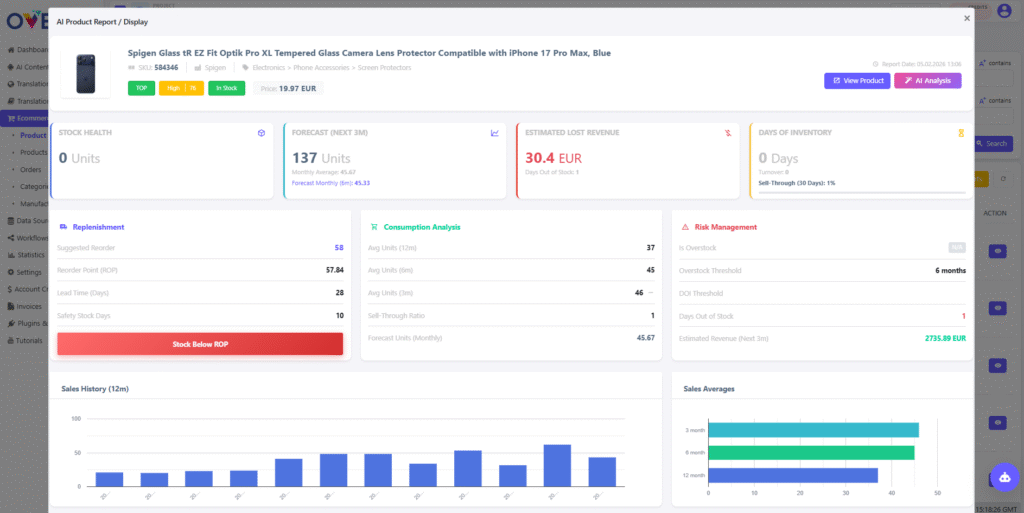
Stock optimization stands at the heart of maximizing profit; AI equips managers with tools for effective inventory control.
Overstock and dead stock are profit drainers that AI addresses through advanced analytics.
These systems suggest optimal stock levels, predict reorder points, and assist in product phase-outs.
Thus, leveraging AI ensures that only necessary inventory is maintained; ecommerce operations become lean and efficient.
Reducing Revenue Loss: AI Impact
The impact of AI on revenue is profound; it significantly diminishes the financial bleeding caused by stockouts.
AI offers predictive warnings, allowing timely stock replenishment.
Cost benefits of adopting AI are clear: improved supply chain management directly translates to better revenue figures.
Examples abound of businesses rejuvenated by AI’s predictive prowess; stockouts are minimized, enhancing both revenue and customer satisfaction. Ecommerce grows more secure under AI’s watchful eye.
The Future of Ecommerce and AI
As ecommerce evolves, AI will play a pivotal role in crafting personalized solutions tailored for specific industries.
Its ability to align with both operations and marketing will forge a more integrated commercial ecosystem.
The future heralds even greater AI involvement, as sector-specific tools are refined and implemented.
Staying informed and prepared for these advancements allows ecommerce managers to harness the full potential of AI, carving pathways to profitability unseen with conventional methods.