Cycle Counting: Keep Stock Accurate Without Full Inventory Counts
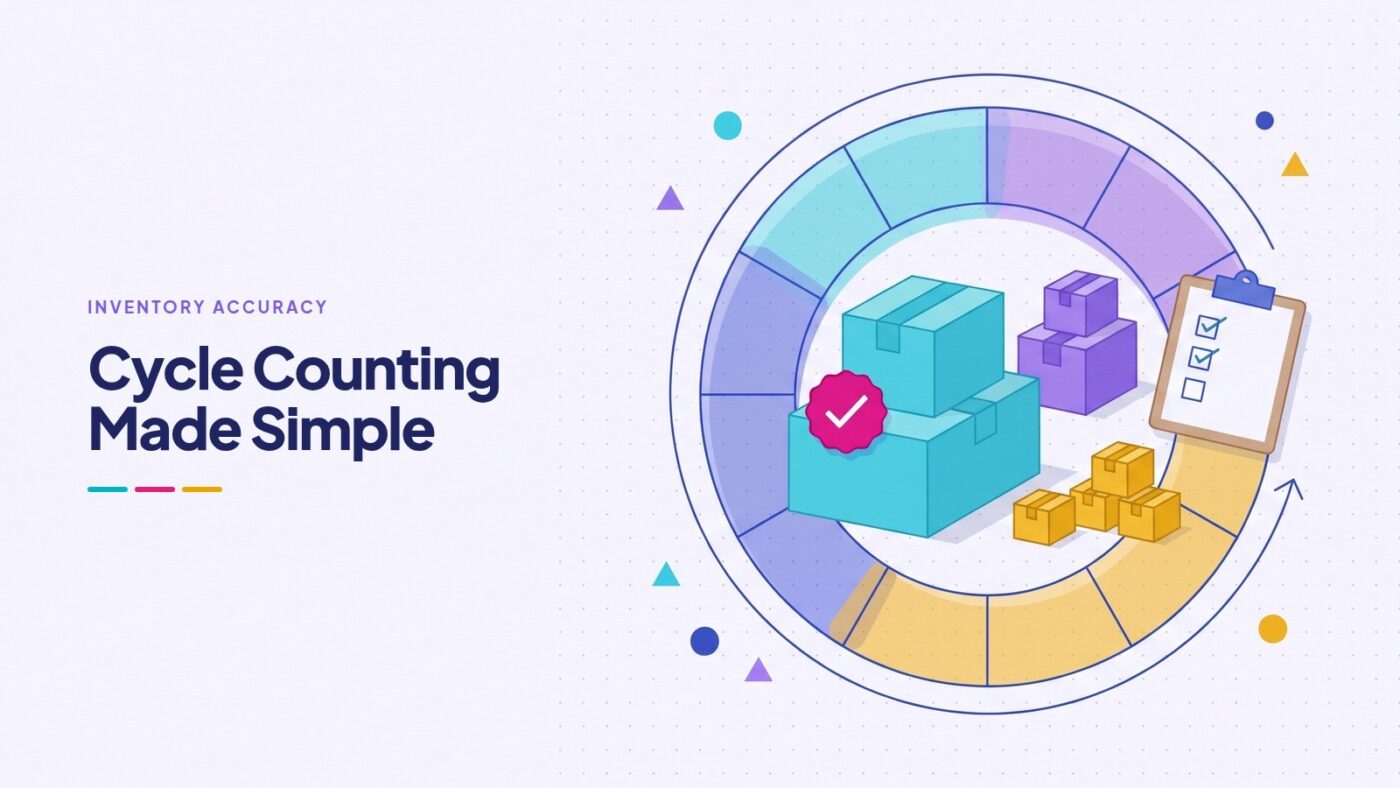
Short answer: cycle counting keeps inventory records accurate by counting a small group of products on a rotating schedule, every day or every week, instead of shutting down for one big physical count a year. Valuable, fast-selling items are counted often and cheap, slow-moving ones rarely, and every gap between shelf and system is corrected and traced to its cause. For an online store it matters because product pages, reorder points and forecasts all trust the stock number in the system.
Below: why stock records drift, the main counting methods, a six-step setup, a worked schedule for 2,000 products, how to measure accuracy, and how Ovesio eCommerce Intelligence turns accurate stock data into reorder decisions.
Key takeaways
- Most stock records are wrong. A study of nearly 370,000 inventory records in 37 stores of one retailer found 65% of them inaccurate.
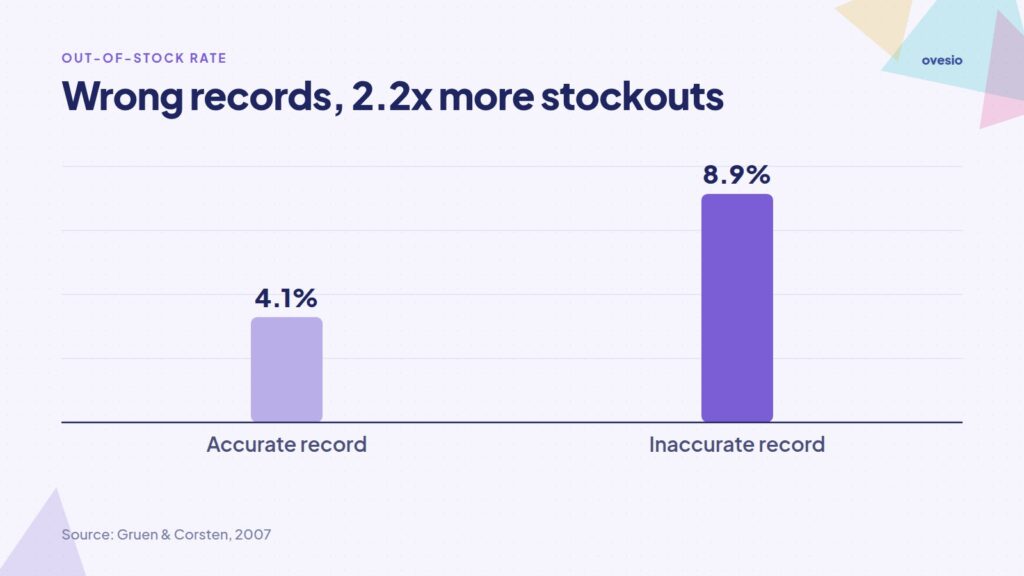
- Wrong records cause stockouts. In one retail audit, items whose records did not match the shelf were out of stock 8.9% of the time, against 4.1% for items with accurate records.
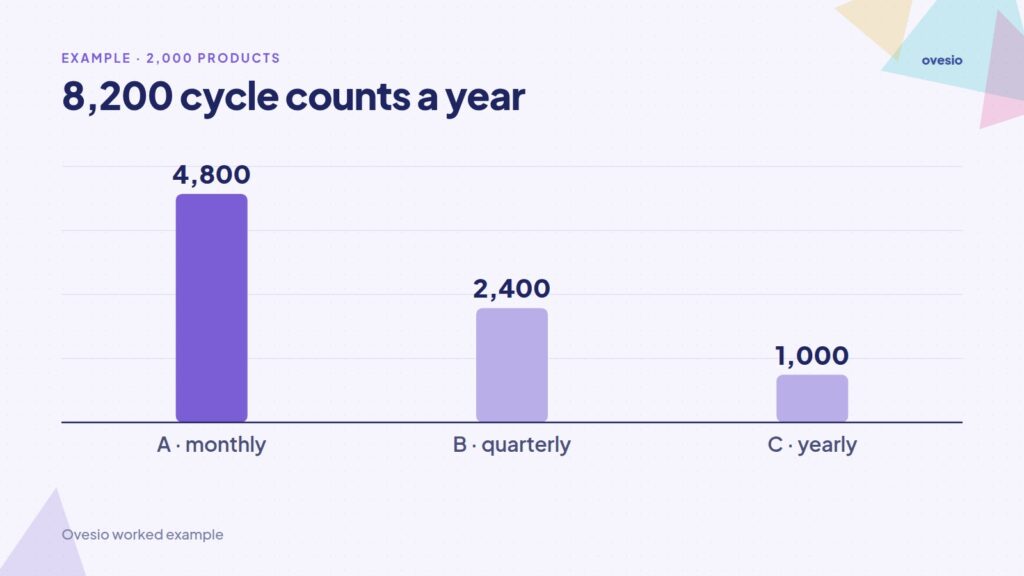
- Count by value and risk. Counting A items monthly, B items quarterly and C items yearly means 8,200 counts a year for 2,000 products, about 33 a day.
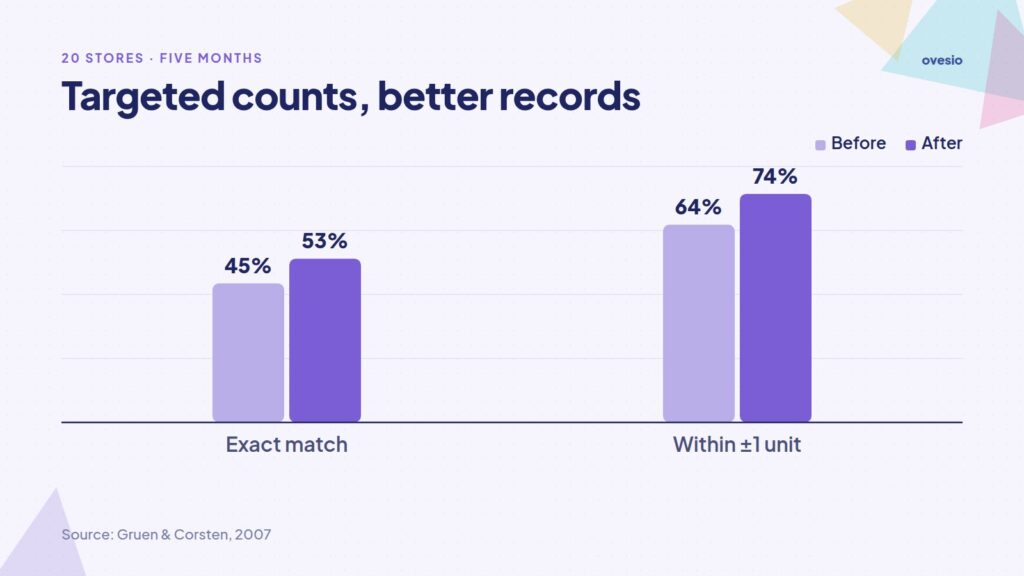
- Smarter beats more. A retailer that targeted the products most likely to be wrong raised exact record accuracy from 45% to 53% with 20% fewer counts.
What is cycle counting?
Oracle’s inventory documentation defines cycle counting as “the periodic counting of individual items throughout the course of the year to ensure the accuracy of inventory quantities and values.” It can run instead of complete physical inventories or side by side with them. You count a little all the time, so errors surface within weeks instead of at year end.
Each count compares the shelf with the system for one product or location. If the count is within tolerance, it is a hit; if not, you recount, adjust the record and find the cause.
| Cycle counting | Full physical inventory | |
|---|---|---|
| What is counted | A few products or locations at a time | Everything at once |
| How often | Daily or weekly, all year | Usually once or twice a year |
| Operations | Run alongside picking and shipping | Shipments often paused |
| Errors found | Within days or weeks | Months after they happened |
| Root causes | Easy to trace, the trail is fresh | Hard to trace, the trail is cold |
Why inventory records drift
Records start correct and drift one small error at a time. Nicole DeHoratius and Ananth Raman examined nearly 370,000 inventory records from 37 stores of one retailer and found 65% to be inaccurate (Management Science, 2008). Inventory auditing practices reduced inaccuracy; complex store environments and distribution structures increased it.
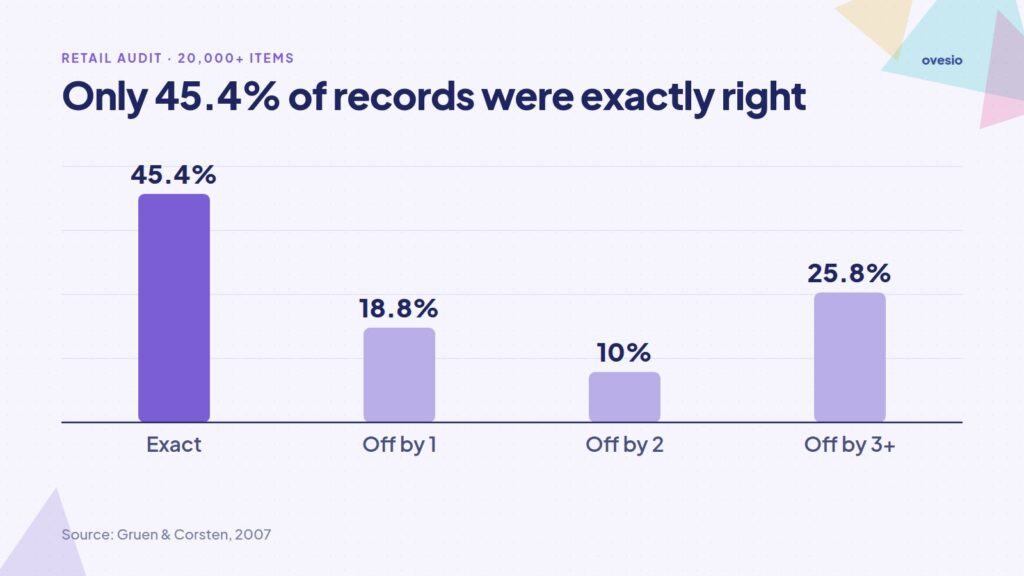
A retail out-of-stock guide by Thomas Gruen and Daniel Corsten, published by GMA, FMI and NACDS, shows a similar picture. In an audit of more than 20,000 items at a major U.S. retail chain, the system record was exactly right only 45.4% of the time:
| Record vs shelf | Share of items audited |
|---|---|
| Exactly right | 45.4% |
| Off by 1 unit | 18.8% |
| Off by 2 units | 10.0% |
| Off by 3 or more units | 25.8% |
The guide lists the usual causes, all with direct equivalents in an online store: scanning the wrong item at checkout (for a web shop, at packing), which creates two wrong records at once; theft and damaged goods never written off; manual edits and bad adjustments; product lost in the backroom; and mislabeled cases or master data errors.
Shrink alone is a big source of drift. The National Retail Federation’s 2023 National Retail Security Survey put the average shrink rate at 1.6% for fiscal 2022, or $112.1 billion across U.S. retail, with internal and external theft accounting for nearly two-thirds (65%) of it. Every unit that disappears without a transaction is a unit your system still believes you have.
What wrong stock records cost you
The audits in the Gruen and Corsten guide found errors split roughly half and half between two kinds:
- Phantom inventory: the system shows more than you have, so the reorder point may never trigger. In their example, a slow seller with 1 unit on the shelf and 3 in the system sells its last unit; the system still shows 2, and the item can stay out of stock for weeks. An online store keeps selling it, then cancels orders.
- Hidden inventory: the system shows less than you have. You reorder too early and add to the slow-moving stock that later becomes deadstock.
At the retailer they studied, items with accurate records were out of stock 4.1% of the time, against 8.9% for items with inaccurate records, about 2.2 times more often. What each missed sale really costs is covered in our guide to stockout cost.
Bad records also corrupt your data. While phantom inventory hides a stockout, the product’s sales fall to zero, and a forecast or a sales trend analysis reads that as falling demand.
Cycle counting methods
| Method | How it works | Best for |
|---|---|---|
| ABC counting | Rank products by value; count A items most often, C items least | The backbone of most programs |
| Location counting | Count every product in one zone or bin, moving through the warehouse | Finding misplaced stock |
| Threshold counting | Count a location when its quantity drops below a set level | Quick counts when little is left |
| Exception counting | Count products whose records look suspicious | Catching likely errors first |
| Random sample | Count a random set of products | Measuring overall accuracy |
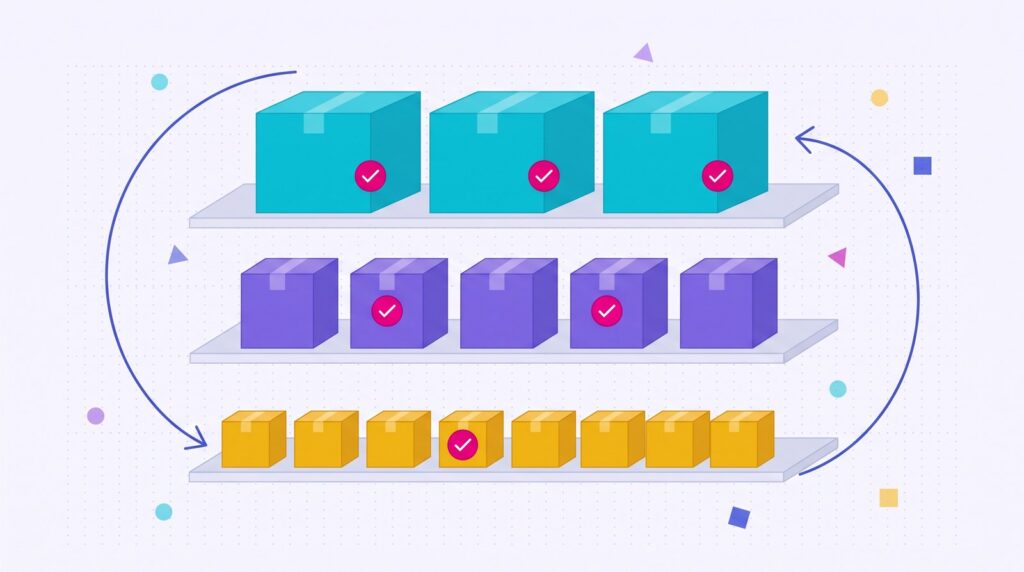
Oracle’s documentation suggests using ABC classes to count high-value A items very frequently, lower-value items less frequently and the lowest-value items very infrequently. Threshold counting is built into Microsoft Dynamics 365: a location holding 60 units with a threshold of 40 gets a count automatically once a pick of 25 leaves 35.
For exception counting, the retailer in the Gruen and Corsten guide checked products whose records showed zero or negative stock, unusually high records, empty shelf spots, high-shrink items and products ending a promotion.
How to set up a cycle count program in six steps
- Measure where you stand. Count a random sample and record how many products match exactly and how many fall within tolerance. Gruen and Corsten expect most companies to start below 50% exact.
- Rank your products. Run an ABC analysis on annual sales value (units sold times unit cost). Move products with high shrink, several locations or frequent errors up one class.
- Set frequencies and a daily list. Inventory software such as Oracle’s uses the number of items in each class, the count frequency and your workday calendar to decide what to count each day or week.
- Count blind. Microsoft’s warehouse app never shows the expected quantity, to prevent intentional miscounts.
- Set tolerances and recounts. Define a miss by percentage or value and recount before large adjustments. In Microsoft’s example, with 50 units on hand and a deviation limit of 10, any count outside 40 to 60 is flagged as a difference to review.
- Fix the cause, not just the number. Group misses by cause every month. The retailer in the Gruen and Corsten guide found that products stored in several locations were the single biggest cause of its errors.
Worked example: a cycle counting schedule for 2,000 products
Take an online store with 2,000 active products and 250 working days a year, ranked by annual sales value. The split below is illustrative; adjust it to your catalog:
| Class | Share | Products | Counts each | Total counts |
|---|---|---|---|---|
| A | 20% | 400 | 12 (monthly) | 4,800 |
| B | 30% | 600 | 4 (quarterly) | 2,400 |
| C | 50% | 1,000 | 1 (yearly) | 1,000 |
| Total | 100% | 2,000 | 8,200 |
That is 8,200 / 250 = 32.8, about 33 counts a day: roughly an hour of work if a count takes two minutes (an assumption; time your own), with no shutdown. A items are 20% of the catalog but get 4,800 of the 8,200 counts, about 59%, because their errors cost the most.
How to measure inventory record accuracy
Inventory record accuracy = counts within tolerance ÷ total counts × 100
Say the store above makes 164 counts in a week (8,200 over 50 weeks) and 141 fall within tolerance: accuracy is 141 ÷ 164 = 86.0%. Judge the first count, not the recount, as Oracle does for its hit/miss percentage. Track it by class, and track adjustment value: one wrong A item can matter more than ten wrong C items.
Targeting beats counting harder. In a five-month test in 20 stores, the retailer in the guide switched to counting the products most likely to be wrong. Exact accuracy rose from 45% to 53%, and accuracy within one unit from 64% to 74%, while total cycle counts fell by 20%.
| Measure | Before | After five months |
|---|---|---|
| Exact record accuracy | 45% | 53% |
| Accurate within ±1 unit | 64% | 74% |
| Number of cycle counts | baseline | 20% fewer |
How Ovesio works with your cycle counts
Ovesio does not count your shelves; your team or warehouse system does. Ovesio eCommerce Intelligence turns your store’s sales and stock data into actions: what to reorder, when and how much. Those actions are only as good as the stock numbers behind them, so cycle counting and Ovesio work as a pair:
- Count before you buy. Ovesio calculates time to stock-out, days of inventory and a reorder point with safety stock in days. Count the products on a large purchase order before approving it, so you never buy on a phantom number.
- Spot suspicious records. Anomaly detection flags unusual patterns automatically. A product that suddenly stops selling while the system shows plenty of stock belongs on tomorrow’s count list.
- See what stockouts cost. Lost sales tracking records sales lost during out-of-stock periods, and lost sales intelligence estimates missed opportunities even without perfect stock logs.
- Spot excess stock. Overstock detection and an UP, DOWN or FLAT trend for each product you track show where stock piles up, including across several sales channels.
eCommerce Intelligence is included in every Ovesio plan, and its reports do not consume AI credits. On the pricing page, the current monthly offers are €49 for Basic (list price €69, 1,000 reports), €89 for Standard (list price €109, 5,000 reports) and €149 for Advanced (list price €169, 50,000 reports), excluding VAT; annual plans cost €539, €949 and €1,490. If you also use AI translation or product descriptions, the pricing calculator estimates the credits you need. Ovesio connects through plugins for WooCommerce, OpenCart, PrestaShop and Magento, or its API; see the integrations page.
Put your corrected stock numbers to work: start a 7-day free trial on any monthly Ovesio plan and see which products eCommerce Intelligence tells you to reorder, slow down or clear. For why manual stock planning breaks down, read the cost of human error in stock planning.
FAQ
How often should you do cycle counting?
It depends on value and risk. One simple setup is the one above: A items monthly, B quarterly, C yearly, plus extra counts for high-shrink or suspicious products.
Does cycle counting replace the annual physical inventory?
It can. Oracle describes cycle counting as an alternative to complete physical inventories, or a technique to use alongside them. Whether you can drop the year-end count depends on your accounting and audit requirements, so check with your accountant or auditor.
What is a good inventory record accuracy?
There is no single benchmark; it depends on your tolerance and counting method. Most businesses start lower than they think, so set a target per class, measure weekly and watch the trend.
Sources
- Nicole DeHoratius and Ananth Raman, Inventory Record Inaccuracy: An Empirical Analysis, Management Science 54(4), 2008, pp. 627-641.
- Thomas W. Gruen and Daniel Corsten, A Comprehensive Guide to Retail Out-of-Stock Reduction in the Fast-Moving Consumer Goods Industry, GMA, FMI, NACDS and University of Colorado at Colorado Springs, 2007. Section 3-2: The Case for Inventory Accuracy.
- National Retail Federation, Shrink Accounted for Over $112 Billion in Industry Losses in 2022, According to NRF Report (2023 National Retail Security Survey).
- Oracle Inventory Help: Overview of Cycle Counting, Overview of ABC Analysis, Defining Cycle Count Classes and Cycle Count Scheduling.
- Microsoft Learn, Cycle counting (Dynamics 365 Supply Chain Management).
- Ovesio, eCommerce Intelligence, pricing and integrations, read on November 25, 2026.