Back Translation: What It Is, an Example and When Stores Need It
Short answer: back translation is a quality check in which a translated text is translated back into the original language, usually by a second translator who has not seen the source, and the result is compared with the original. Differences point to places where the meaning may have shifted. For an online store, back translation is useful for short, high-risk text such as safety warnings, legal terms, size guidance and slogans. For a whole product catalog it is a poor fit: it doubles the translation work and, as research shows, misses real errors while flagging correct translations.
Key takeaways
- Back translation compares meaning, not quality. A word-for-word translation can come back looking perfect and still read badly to a native speaker.
- The research is skeptical. A 2005 study found round-trip translation a poor predictor of machine translation quality, and a 2017 study of a European survey found that back translation raised false alarms while many problems stayed hidden.
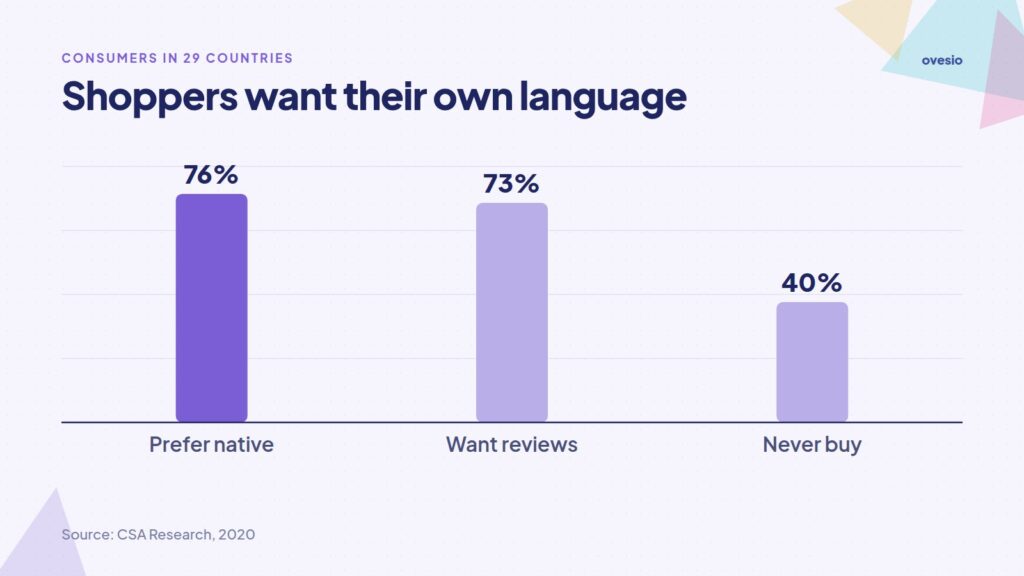
- Language still sells. In CSA Research’s 2020 survey of 8,709 consumers in 29 countries, 76% preferred to buy products with information in their own language and 40% said they never buy from websites in other languages.
- Use it selectively. Back-translate the few lines where a mistake is costly, and rely on native review and automated cross-checks for the rest of the catalog.
What is back translation?
Back translation, also called reverse translation or round-trip translation, works in three steps:
- Forward translation: the source text, say English, is translated into the target language, say German.
- Back translation: a different translator, ideally one who has not seen the English original, translates the German version back into English.
- Comparison: someone who reads only English compares the two English versions and flags every place where the meaning differs. Each flag goes back to the translators for a decision.
The method comes from research and healthcare, where questionnaires must mean the same thing in every language. The widely cited process from Beaton and colleagues (2000) uses two independent forward translations, a synthesis of the two, two back translations, an expert committee review and a pretest with real respondents. Back translation is one step in that chain, not the whole check.
What does back translation look like in an online store?
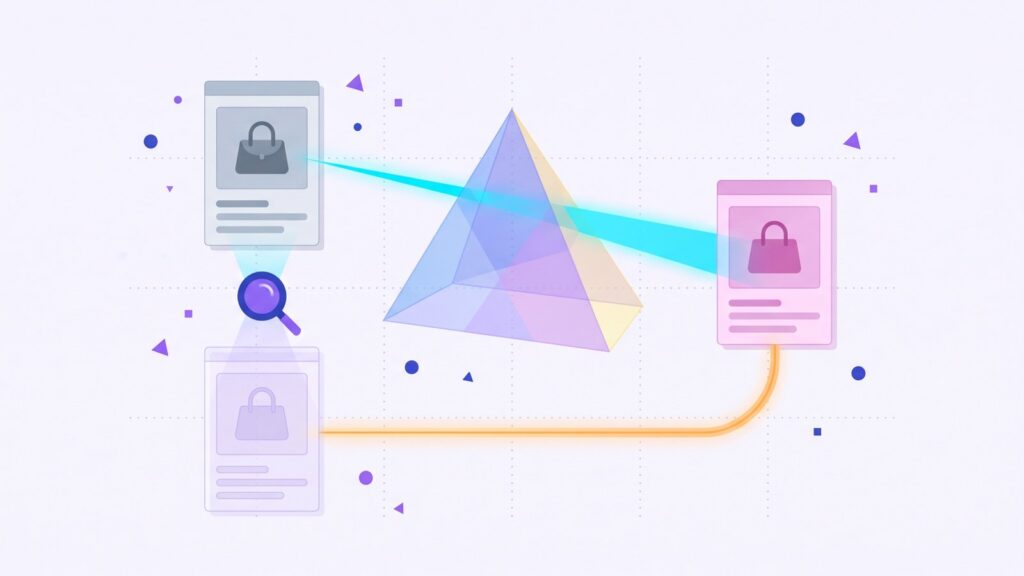
Here is how back translation behaves on lines from an English fashion store translated into German, with literal back translations.
| English source | German translation | Literal back translation | What the check says | Reality |
|---|---|---|---|---|
| Free shipping on orders of €50 or more | Kostenloser Versand ab 50 € Bestellwert | Free shipping from €50 order value | Match | Correct |
| This dress runs small | Dieses Kleid läuft klein | This dress runs small | Perfect match | Wrong: a word-for-word calque, not natural German |
| This dress runs small | Dieses Kleid fällt klein aus | This dress falls out small | Meaning changed? | Correct: the natural German phrase |
The second row is the dangerous one. A word-for-word translation of an idiom comes back as the same idiom, so the comparison looks flawless, yet the German sentence is not natural German, and many shoppers would not know what it means. The third row is the opposite problem: the correct, idiomatic German sounds odd when translated back literally, so the check raises a false alarm. A confusing sizing line can mean wrong sizes and returns, and back translation would have approved it.
What does research say about back translation?
The example is not a corner case. Research points the same way:
- Round-trip machine translation is a weak test. Harold Somers (University of Manchester, 2005) ran two experiments with free online translation systems and found round-trip translation to be “a poor predictor of quality,” with high scores for the round trip even when the forward translation was poor.
- Human back translation misses problems too. Dorothée Behr (GESIS, 2017) studied the back translation documentation of the 2012 European Quality of Life Survey. Different people comparing the same back translation flagged different “presumed flaws,” and native-speaker checks showed that back translation “causes quite a number of false alarms” while “many problems remain hidden.”
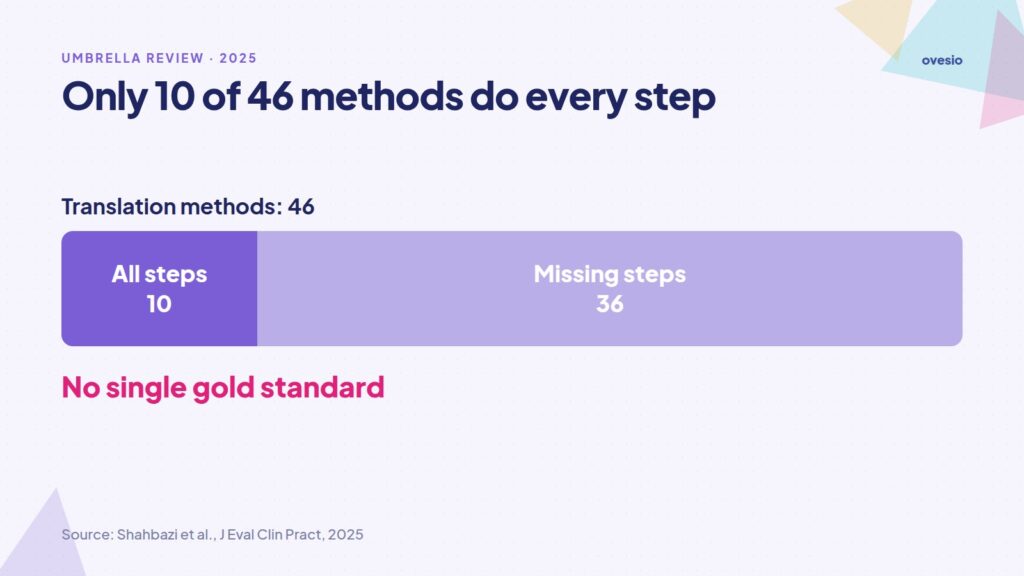
- There is no single gold standard. A 2025 umbrella review of 19 reviews identified 46 different methods for translating and adapting health questionnaires. Only 10 of them fully implemented all the essential steps, and the authors recommend multistep processes with expert committee review and cognitive testing with real respondents.
Why does translation quality matter for online stores?
Shoppers notice. CSA Research’s “Can’t Read, Won’t Buy” survey (July 2020, with Kantar) found:
| Finding (CSA Research, 2020) | Share of consumers |
|---|---|
| Prefer to buy products with information in their native language | 76% |
| Want product reviews in their language | 73% |
| Prefer content in their language even if its quality is poor | 65% |
| Never buy from websites in other languages | 40% |
| Buy only at local-language websites, German respondents | 57% |
Search engines care as well. Google’s spam policies define “scaled content abuse” as generating many pages “for the primary purpose of manipulating search rankings and not helping users.” One listed example is scraping content to create many pages, “including through automated transformations like synonymizing, translating, or other obfuscation techniques,” where little value is provided to users. Translating product pages for real customers is not the problem; publishing thousands of unchecked, unhelpful pages can be.
When should an online store use back translation?
Back translation earns its cost when a mistake would be expensive and nobody on your team reads the target language:
- Safety and usage warnings on products such as toys, cosmetics, electrical goods or supplements.
- Legal and checkout text: return policy, warranty, terms of sale, subscription and cancellation wording. Have a lawyer or qualified translator in that market sign off as well.
- Product claims such as “waterproof,” “organic” or “hypoallergenic,” where a shifted meaning can become a false promise.
- Slogans, brand names and campaign headlines, to catch an unwanted second meaning before launch.
For everyday catalog content, such as thousands of product descriptions and meta tags, a full back translation is slow and not very reliable. Other checks work better there.
How does back translation compare with other quality checks?
| Check | Good at catching | Weak spot | Best for |
|---|---|---|---|
| Back translation | Shifts in meaning, omissions | Literal errors pass; correct idioms look wrong | Short, high-risk text |
| Native-speaker review | Unnatural phrasing, tone, cultural fit | Slow and costly at catalog scale | Key pages, legal text, samples |
| Comparing several translation engines | Errors one engine makes and others do not | Shared blind spots across engines | Large catalogs |
| Glossary and translation memory | Inconsistent product and brand terms | Only covers terms you define | Every catalog |
How much extra work does a full back translation add?
Take a store that adds 500 new products a month, with about 1,500 characters of text per product (the estimate Ovesio uses on its pricing page), translated into three languages.
| Approach | Calculation | Characters translated per month |
|---|---|---|
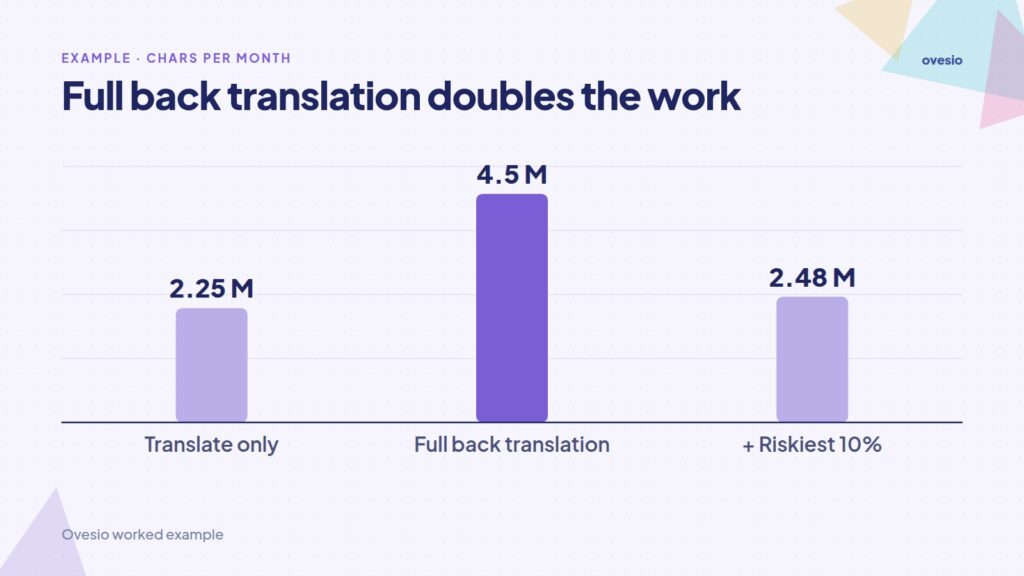
| Forward translation only | 500 × 1,500 × 3 | 2,250,000 |
| Plus a full back translation | 2,250,000 × 2 | 4,500,000 |
| Plus back translation of the riskiest 10% | 2,250,000 + 225,000 | 2,475,000 |
A full back translation doubles the volume and adds 1,500 manual page comparisons a month. Back-translating only the riskiest 10% adds just 225,000 characters, leaving budget for native review of your best-selling pages.
How should a store check translation quality?
- Build a glossary first: brand names, product names and terms that must never be translated or must always be translated the same way.
- Tag high-risk text (warnings, legal, claims, sizing) and send only that through back translation by a separate translator.
- Have a native speaker review your top-selling pages and a random sample from each category in every language.
- Do not run a round trip through the same machine translation engine and treat a match as proof of quality.
- Watch customer signals per language: size-related returns, support questions and confused reviews.
How does Ovesio check translation quality across a whole catalog?
Ovesio AI Translation is built for the catalog-scale part of the problem, where back-translating every product is not realistic. Instead of trusting one engine, it cross-checks several:
- Several engines per text. Ovesio offers five different translators and recommends using at least three. Engines it works with include Google Translate, DeepL, Microsoft Translator, OpenAI and Gemini.
- AI Inspector. Ovesio’s quality control layer compares the outputs and chooses the best parts of each version to compile the most accurate translation. Read more in What is the Ovesio AI Inspector?
- AI approval. An AI check evaluates each translation for accuracy, grammar, fluency and coherence; translations that meet the standard are approved automatically and doubtful ones are flagged for review. See how AI approval works.
- Glossary, translation memory and context, so product terms stay consistent and the engines know, for example, that they are translating electronic products.
- Manual edits and automatic updates. You can review and edit results in the platform or your CMS, and when you change the original text, the translation is updated automatically.
To be clear about the limits: Ovesio does not replace a lawyer or a certified translator for legal text, and it does not perform human back translation. It gives you a cross-checked translation of the whole catalog in 30+ languages (see the supported languages), so your own review time and any back translation can go to the few lines that need them.
AI Translation is included from the Standard plan, listed on the pricing page at €89 a month excluding VAT (an offer price, down from €109) with credits for up to about 3.9 million translated characters, or roughly 2,600 products at 1,500 characters each, if all credits go to translation. The Advanced plan, at €149 a month (down from €169), covers up to about 7.3 million characters. The forward translation in the worked example above (2,250,000 characters a month) falls within Standard’s estimate; actual credit use depends on the languages and workflow you choose. Use the cost calculator to estimate your own catalog. Ovesio connects to WooCommerce, OpenCart, PrestaShop and Magento through plugins, or to any platform through its API; see the integrations page.
For more on choosing engines, see our guides on getting accurate AI translation for ecommerce and Google Translate API pricing.
Try it on your own products: the monthly plans come with a 7-day free trial. Start your Ovesio trial and compare the translations with what your back translation or native reviewer finds.
Back translation FAQ
Is back translation the same as reverse translation?
Yes. Back translation, reverse translation and round-trip translation all describe translating a text back into its original language to compare it with the source. “Round-trip translation” is used most often when the same machine translation system does both directions.
Can I use Google Translate for back translation?
You can, but a clean round trip proves little: research on free online systems found that round trips can score well even when the forward translation is poor. Use a different translator for the return trip and treat the output as a list of questions, not a verdict.
How many back translators do you need?
In clinical and survey research, the widely cited Beaton process uses two independent back translations, reviewed by an expert committee. For a store’s warnings or legal text, one independent back translator plus a native reviewer in the target market is a practical minimum.
Does Google penalize machine-translated product pages?
Not for being translated as such. Google’s spam policies target pages generated at scale mainly to manipulate rankings, for example scraped content run through automated translation, when they add little value for users. Accurate product pages for real customers in their language are a different case, so check quality before you publish.
Sources
- Somers, H., Round-trip Translation: What Is It Good For?, Proceedings of the Australasian Language Technology Workshop 2005, pages 127-133
- Behr, D., Assessing the use of back translation: the shortcomings of back translation as a quality testing method, International Journal of Social Research Methodology 20(6), 2017
- Shahbazi, M. et al., An Umbrella Review of Various Methods for Translating and Culturally Adapting Self-Reported Health Instruments, Journal of Evaluation in Clinical Practice 31(8), 2025
- Beaton, D. E. et al., Guidelines for the process of cross-cultural adaptation of self-report measures, Spine 25(24), 2000; process as applied in Gjersing, L. et al., Cross-cultural adaptation of research instruments, BMC Medical Research Methodology 10:13, 2010
- CSA Research, Consumers Prefer their Own Language (Can’t Read, Won’t Buy, B2C), press release, July 7, 2020
- Google Search Central, Spam policies for Google web search, scaled content abuse
- Ovesio, AI Translation, pricing, FAQ and integrations pages (accessed November 2026)