Human vs Machine Translation for Product Pages: When to Use Each
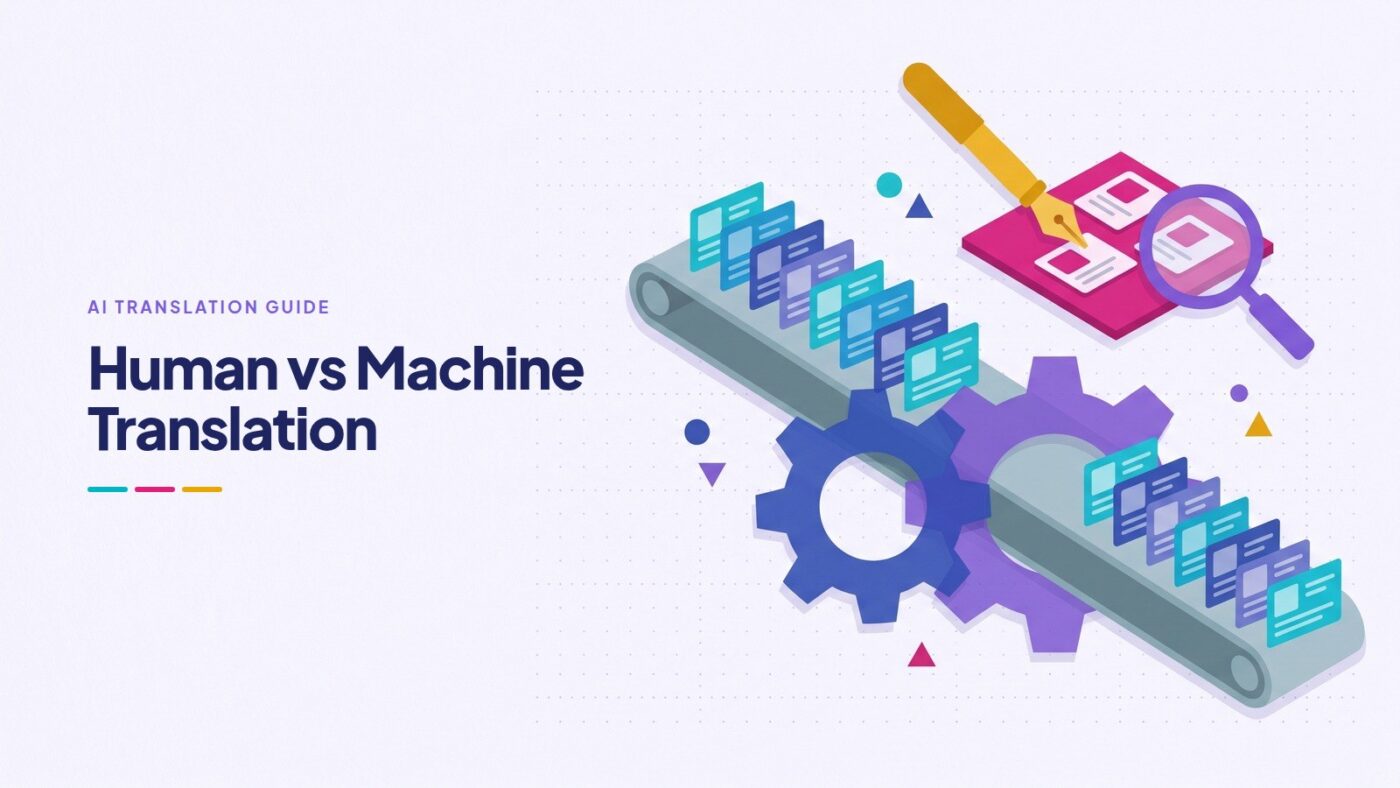
Short answer: in the human vs machine translation debate, an online store does not have to pick one side. Machine translation is the right default for the bulk of a product catalog: names, attributes, specifications and long-tail descriptions. Human translators earn their fee where one wrong word is expensive: legal terms, safety warnings, slogans, your homepage and your bestsellers. Research backs this split. Professional translators still beat machines in careful, document-level evaluations, but the best systems now come close, and post-editing machine output makes translators faster.
Key takeaways
- Machines are close, not equal. In the WMT24 evaluation, professional human translations were in the top-ranked group in 7 of 11 language pairs, and the best English to Spanish systems were “close to flawless.”
- Shoppers want their language first. In CSA Research’s survey of 8,709 consumers in 29 countries, 76% preferred product information in their own language and 40% said they never buy from websites in other languages.
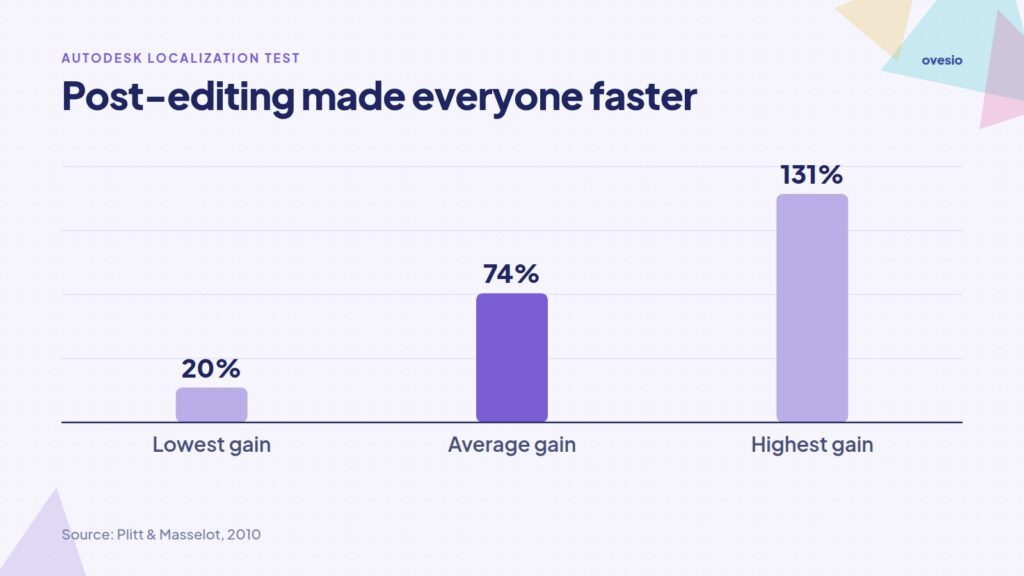
- Post-editing beats starting from scratch. In a test at Autodesk, editing machine output raised translator throughput by 74% on average compared with translating from scratch.
- Tier your content. Machine-translate the catalog, then spend human time on the small share of text that carries legal, safety or brand risk.
Human vs machine translation: how do they compare?
Machine translation (MT) is text translated by software: neural engines such as Google Translate, DeepL and Microsoft Translator, or large language models such as GPT and Gemini. Human translation is done by a professional who understands both languages and the market. A third option sits in between: post-editing, where a human reviews and corrects machine output instead of translating from a blank page. For what the machine side costs per character, see our breakdown of Google Translate API pricing.
| Factor | Machine translation | Human translation |
|---|---|---|
| Speed | Seconds to hours for a full catalog | About 2,500 words per translator per day, a common industry rule of thumb |
| Cost | Fractions of a cent per word | Paid per word or per hour |
| Consistency | Same term every time, especially with a glossary | Depends on the translator and the style guide |
| Nuance and tone | Good on plain, factual text; weaker on idioms, puns and slogans | Strong, especially with market knowledge |
| Context | Often sees one sentence or one field at a time | Reads the whole page and asks questions |
| Accountability | No one signs off unless you add a review step | A named professional is responsible for the text |
How good is machine translation now?
Better than its reputation, but not as good as the marketing claims. Three major evaluations show why:
- Context changes the verdict. Läubli, Sennrich and Volk (EMNLP 2018) re-tested a claim that neural MT had reached human parity in Chinese to English news. When raters judged whole documents instead of isolated sentences, they preferred the human translations more strongly.
- Experts see what crowds miss. A Google Research study by Freitag and colleagues (TACL 2021) had professional translators mark errors with full document context. Their ranking differed substantially from the one produced by crowd workers and showed a clear preference for human translations over machine output.
- The gap is narrowing. The WMT24 shared task compared submitted systems, 8 large language models and 4 online translation services against professional reference translations. The human references were in the winning group in 7 of 11 language pairs, so in the other four, at least one machine system ranked above them (for English to Hindi, the organizers note the reference quality was weak). The paper’s title sums it up: “The LLM Era Is Here but MT Is Not Solved Yet.”
For a store, modern MT is good enough for most factual product text in major language pairs, and still risky where tone, legal meaning or cultural fit decide the outcome. Quality also varies by engine and language pair. We covered that in how Ovesio chooses the best translation.
What do shoppers actually expect?
Shoppers care more about reading the page in their own language than about who translated it. CSA Research surveyed 8,709 consumers in 29 countries for its 2020 “Can’t Read, Won’t Buy” study:
| Finding | Share of consumers |
|---|---|
| Prefer products with information in their own language | 76% |
| Use online machine translation | 66% |
| Prefer content in their language, even if it is poor quality | 65% |
| Will not buy from websites in other languages | 40% |
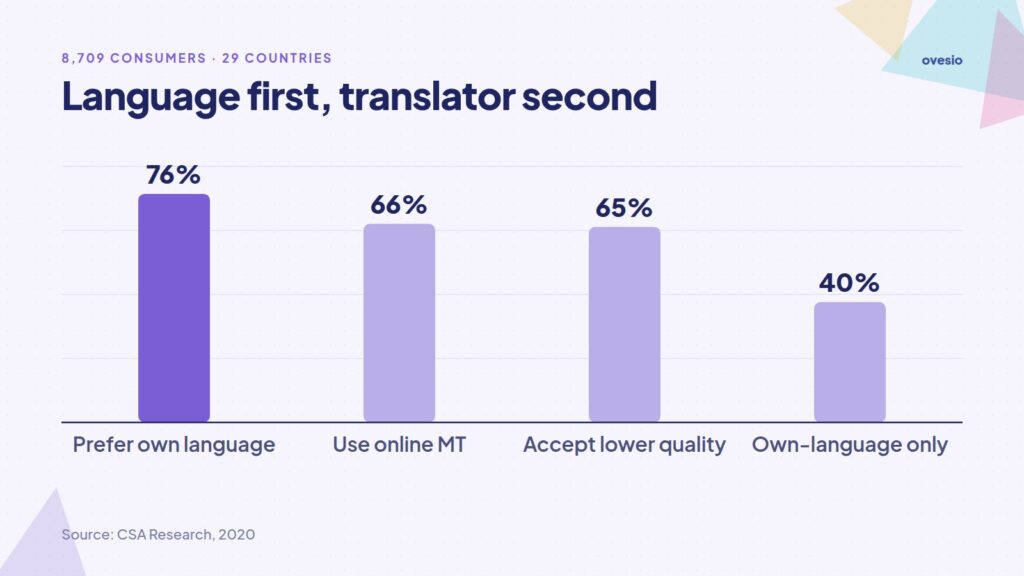
An untranslated catalog loses buyers outright, so waiting months for a fully human translation has a real cost. And two-thirds of shoppers already use machine translation themselves: a reviewed translation on your site beats the raw browser version they would otherwise see. “Even if it is poor quality” is a tolerance, not a target: errors in sizes, materials or return terms still lead to returns and complaints, as we explain in our guide to back translation.
Which product content needs a human translator?
Sort your content by the cost of a mistake, not by page type. This is the split we recommend:
| Content | Risk if wrong | Recommended approach |
|---|---|---|
| Product names, attributes, filters, specifications | Low to medium | Machine translation with a glossary and do-not-translate list |
| Long-tail product descriptions | Low | Machine translation, plus spot checks on a sample |
| Category pages and SEO meta tags | Medium | Machine translation, native review of your top categories |
| Bestsellers, homepage, landing pages | High (most traffic and revenue) | Machine draft plus full human post-editing |
| Slogans, campaign headlines, brand claims | High (tone and culture) | Human copywriting in the target language (transcreation) |
| Terms, returns policy, privacy, safety warnings, instructions | Very high (legal and safety) | Qualified human translator, legal check where required |
The first three rows are where most of a catalog’s words sit, so they are where machine translation saves the most time and money. The last three rows are short but expensive to get wrong, so that is where human time pays off.
Worked example: 2,000 products in three languages
Take a store with 2,000 products expanding into German, French and Spanish. We use Ovesio’s own sizing assumption of about 1,500 characters per product, which is roughly 250 English words at about six characters per word, spaces included.
| Step | Calculation | Result |
|---|---|---|
| Text per language | 2,000 products x 1,500 characters | 3 million characters (about 500,000 words) |
| Text for three languages | 3 x 3 million characters | 9 million characters (about 1.5 million words) |
| Fully human translation | 1.5 million words / 2,500 words per day | 600 translator-days |
| Human work on the top 10% only | 150,000 words / 2,500 words per day | 60 translator-days |
| Machine translation of everything with Ovesio | 9 million characters vs up to about 7.3 million per month on Advanced | Two months of Advanced (2 x €149 at the current offer price) |
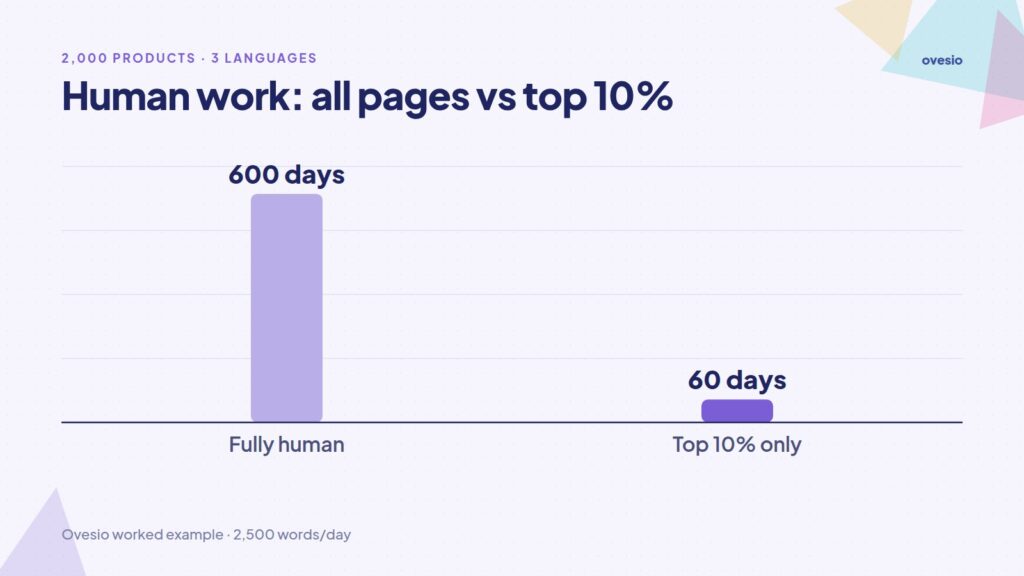
The hybrid plan cuts human work by 90%, from 600 to 60 translator-days, and those 60 days go to the pages that bring in the most revenue. Post-editing can shorten them further. In Plitt and Masselot’s test with twelve participants at Autodesk, translating from English into French, Italian, German and Spanish, editing machine output raised throughput by 74% on average, with gains ranging from 20% to 131% per person. That study used 2010-era statistical MT, so treat the numbers as an illustration rather than a forecast for modern engines.
Large institutions work the same way. In 2025, the European Commission’s translation department, with 1,895 staff, produced 2,499,000 pages in the EU’s 24 official languages, while its eTranslation machine translation service processed more than 890 million pages. Machines carry the volume; people handle the texts that must be exactly right.
How to set up a hybrid translation workflow
- Rank your pages. Export products by revenue or traffic and mark the top 5-10%, plus every legal and safety text.
- Build a glossary first. List brand names, product line names and technical terms that must never change, and the approved translation of key terms such as sizes and materials.
- Machine-translate the full catalog. Translate every product, category and meta tag so no shopper lands on an English-only page.
- Send the top tier to native reviewers. Ask for full post-editing of bestsellers and landing pages, and human translation for legal text.
- Spot-check the rest. Have a native speaker read a random sample of 20-30 products per language each quarter and feed every recurring error back into the glossary.
- Keep translations in sync. When the source text changes, the translations must change too, or prices, sizes and claims drift apart between languages.
How Ovesio handles the machine side of the workflow
Ovesio is built for the machine side of this workflow. Ovesio AI Translation does not rely on a single engine. A workflow can use up to five translators (Google Translate, Microsoft Translator, DeepL Pro, OpenAI and Gemini), and the Ovesio AI Inspector compares their versions and compiles the most accurate one. You can read more in what the Ovesio AI Inspector is.
Several features map directly onto the hybrid steps above:
- Glossary and protected terms: Ignored Translations keep brand names and acronyms unchanged, Pre-Defined Translations lock approved terms, and Replace Words swaps terms in current and future translations.
- Human review stays possible: after automatic translation you can review and edit the results in the platform or in your store’s CMS.
- Automatic sync: when you change the original text, the translation is updated automatically.
- Store plugins and API: integrations for WordPress and WooCommerce, OpenCart, PrestaShop and Magento, plus an API with SDKs for custom platforms, in 30+ languages.
- Multilingual SEO: the AI SEO Meta Tags generator creates titles and descriptions for each language, so translated pages can rank too.
On Ovesio’s pricing page, AI Translation starts with the Standard plan at €89 a month at the current offer price (list price €109), which covers up to about 3.9 million characters a month, or roughly 2,600 product translations. Advanced costs €149 a month at the current offer (list price €169) and covers up to about 7.3 million characters a month. Prices exclude VAT, and the pricing calculator estimates the credits for your own catalog. Ovesio does not supply human translators, so pair it with your own reviewers or a freelancer for the top tier.
Try it on your own catalog: the monthly plans include a 7-day free trial. Translate a category, have a native speaker review it, and decide with real output in front of you. See the plans and start your trial.
FAQ
Is machine translation as good as human translation?
Not yet across the board. In WMT24, professional human translations were still in the top group in 7 of 11 language pairs, while the best English to Spanish systems were close to flawless. For factual product text in major languages, good MT is usually publishable; for legal, safety and brand text, use a human.
What is machine translation post-editing?
A human translator reviews and corrects machine output instead of translating from scratch. Light post-editing fixes errors that change the meaning; full post-editing also polishes style and tone so the text reads as if it were written in that language.
Will machine translation replace human translators?
The US Bureau of Labor Statistics projects 2% employment growth for interpreters and translators from 2025 to 2035 and notes that AI tools are making their work more efficient. The role is shifting toward review, post-editing and high-stakes text. We look at this in more depth in Is AI replacing translators now?
Does Google penalize machine-translated pages?
Google’s spam policies target pages generated at scale mainly to manipulate rankings, including scraped content passed through automated translation that adds little value for users. Accurate product pages that serve real shoppers in their language are a different case. Check quality before you publish, and see how to get accurate AI translation for ecommerce.
Sources
- Läubli, S., Sennrich, R. and Volk, M., Has Machine Translation Achieved Human Parity? A Case for Document-level Evaluation, EMNLP 2018
- Freitag, M. et al., Experts, Errors, and Context: A Large-Scale Study of Human Evaluation for Machine Translation, Transactions of the ACL 9, 2021
- Kocmi, T. et al., Findings of the WMT24 General Machine Translation Shared Task: The LLM Era Is Here but MT Is Not Solved Yet, WMT 2024
- Plitt, M. and Masselot, F., A Productivity Test of Statistical Machine Translation Post-Editing in a Typical Localisation Context, The Prague Bulletin of Mathematical Linguistics 93, 2010
- CSA Research, Consumers Prefer their Own Language (Can’t Read, Won’t Buy, B2C), press release, July 7, 2020
- European Commission, DG Translation key figures (accessed November 2026)
- US Bureau of Labor Statistics, Occupational Outlook Handbook: Interpreters and Translators
- Google Search Central, Spam policies for Google web search, scaled content abuse
- Ovesio, AI Translation, pricing, FAQ and integrations pages (accessed November 2026)