Meta AI Translator: Best Or Worst Free AI Translator
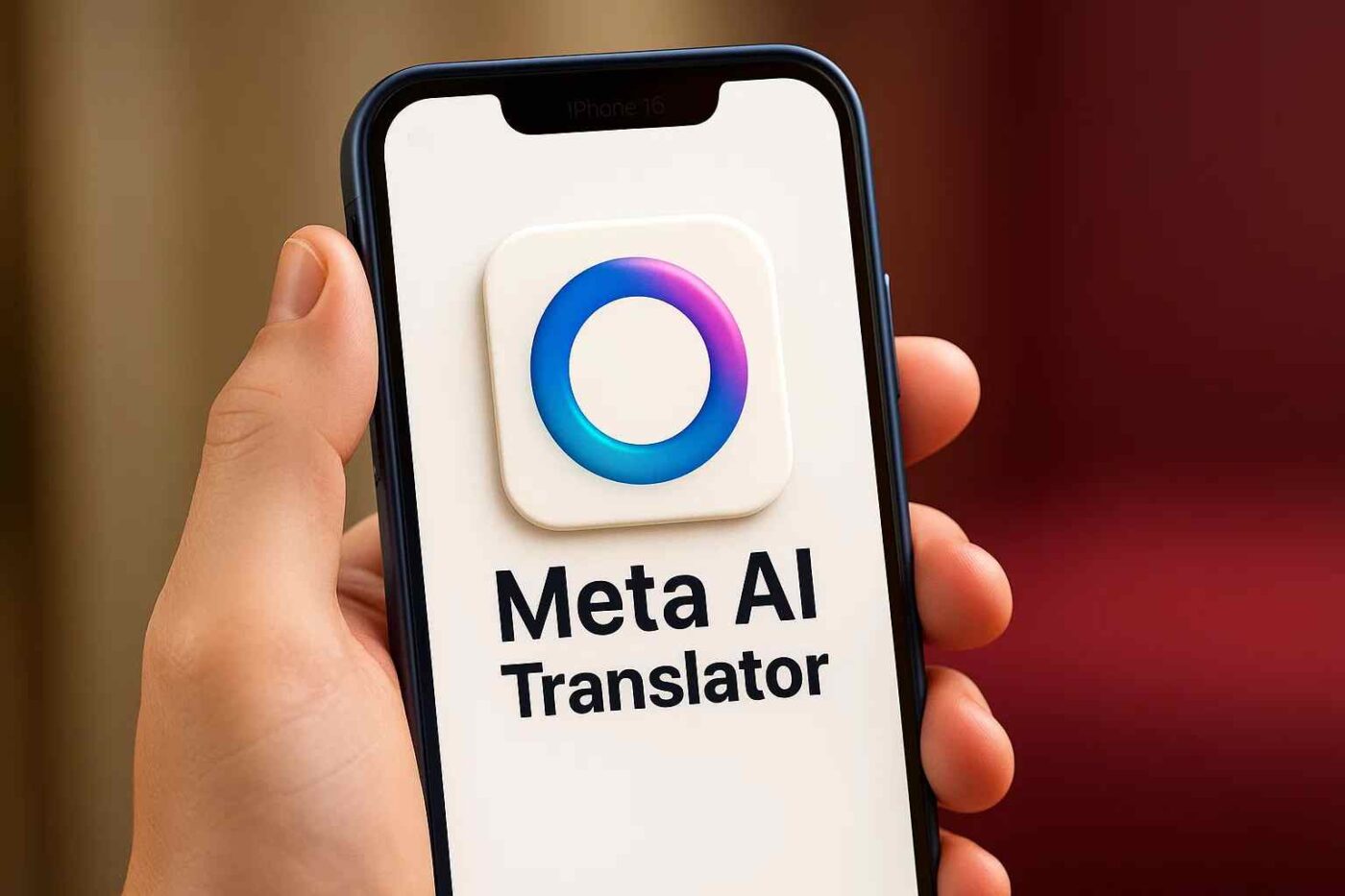
The Meta AI translator is a good free tool for casual use, but not a reliable choice for translating an online store. Meta’s translation features in Facebook and Instagram cost nothing, and the Meta AI assistant will translate text when you ask. In our idiom test, though, it rendered two of five phrases word for word, and it offers none of the catalog workflow a store needs.
Here is what the Meta AI translator is, what it costs, how it performed, and what to use when translation affects your sales.
What is the Meta AI translator?
There is no standalone “Meta Translate” app. Meta AI translation shows up in three places:
- Reels translation. Meta AI translates, dubs and lip-syncs Reels on Facebook and Instagram. Meta’s announcement, updated July 14, 2026, lists English, Spanish, Hindi, Portuguese, Bengali, Tamil, Telugu, Marathi and Kannada, with French, German, Italian, Japanese and Korean added on Instagram.
- The Meta AI assistant. You can paste text into the chat and ask for a translation, like with any AI assistant.
- Meta’s models for developers. As of November 2026, Meta’s developer platform centers on the Muse model family (Muse Wonder, Muse Spark, Muse Ember), alongside the open Llama models, available through the Meta Model API.
Is Meta AI free?
Yes for consumers, no for automation.
- In Meta’s apps: Meta says translating Reels is free, for Facebook creators with 1,000+ followers and all public Instagram accounts in countries where Meta AI is available.
- Through the API: the Meta Model API is pay-as-you-go. As of November 2026, Muse Ember costs $0.10 per million input tokens and $0.50 per million output tokens (for requests up to 200K input tokens), and Muse Spark costs $1.25 input and $4.25 output.
One detail matters for store owners: Meta offers a cheaper “Contributor mode” for Muse Spark in exchange for permission to use your prompts and outputs to train future Meta models. In Standard mode, your content is not used for training. If you send unreleased product data, choose accordingly.
Is Meta AI good for translation? Our test
In October 2025 we gave Meta AI five short phrases that machine translation often gets wrong: idioms, proverbs and slang. A pass meant an English translation a native speaker would naturally say. At the time, Meta AI ran on Llama 4; Meta’s current models may perform differently.
| Language | Phrase | Natural meaning | Meta AI output | Verdict |
|---|---|---|---|---|
| Japanese | 猫の手も借りたいほど忙しい | I’m so busy I’d take help from anyone | (I’m) so busy I’d even want a cat to help me | Literal |
| Spanish | Estar en la luna durante la reunión fue un problema. | Daydreaming during the meeting was a problem. | Being spaced out during the meeting was a problem. | Pass |
| Russian | Утро вечера мудренее | Sleep on it; things will be clearer in the morning | The morning is wiser than the evening | Literal |
| Portuguese (Brazil) | Ele ficou de molho o fim de semana inteiro. | He stayed home resting all weekend. | He was laid up all weekend. | Close |
| Italian | In bocca al lupo! | Good luck! | Good luck! | Pass |
Two clear passes, one close and two literal translations. Meta AI kept the meaning in most cases, but it tends to translate proverbs word for word, and it was not consistent. That is acceptable for understanding a message, not for product copy where one odd phrase can cost a sale. For a broader look at the issue, see AI for translation: reliable or not?
How to get better results from the Meta AI assistant
If you use Meta AI for occasional translations, a few habits reduce literal output:
- Name both languages instead of letting the model guess the source.
- Give context, such as “this is a product description for a running shoe”, so ambiguous words get the right meaning.
- Ask for natural phrasing and an equivalent idiom rather than a literal rendering.
- List terms to keep, like brand names and model numbers.
- Check sizes, units and prices yourself before anything goes live.
These tips help with a few texts. They do not scale to a catalog, because you would have to repeat them, and check the result, for every product and every language.

Can you use Meta AI for e-commerce translation at scale?
Technically yes, through the API. In practice, calling a model is the easy part. A store also needs:
- a connection to the catalog that reads products and writes translations back;
- fixed terminology, so brand and product names never change between languages;
- retries, queueing and change detection for thousands of requests;
- a quality check, because a single model gives you no second opinion.
Building and running that around Meta’s models costs far more than the tokens. The same is true of any single model, which is why we compared the options in Best free AI translator for e-commerce and explained the alternatives in How to use AI translation services in e-commerce.
A better option for store translation
Ovesio AI Translation does not rely on one model. It runs several engines (Google Translate, Microsoft Translator, DeepL Pro, OpenAI and Gemini) in one workflow, and the AI Inspector compares their outputs and keeps the best parts. If one engine translates an idiom literally, the others give the Inspector a better option. Ovesio states 95% similarity to human translators at about 1% of agency cost.
For stores, the workflow matters as much as the quality:
- 30+ languages, with plugins for WordPress/WooCommerce, OpenCart, PrestaShop and Magento, plus a REST API and PHP SDK;
- rules for ignored translations (brand names), pre-defined translations, replaced words and translation memory;
- automatic re-translation when the source text changes;
- a 7-day free trial; translation plans start at €109/month (VAT excluded).
Verdict: best or worst free AI translator?
Neither. The Meta AI translator is a useful free option inside Facebook and Instagram, especially for Reels, and it gets the gist of most text. In our test it was less dependable with idioms than you would want for customer-facing copy. For quick personal translations, Meta AI, Google Translate or ChatGPT will all do; if you are weighing ChatGPT, read Is ChatGPT good at translation?
If your product pages need to sell in other languages, try Ovesio free for 7 days and compare the result on your own catalog.