Is ChatGPT good at translation? ChatGPT Review
Yes, ChatGPT is good at translation when the goal is to understand or adapt a text: it keeps context, tone and meaning better than most word-for-word tools. It is less dependable when you need the same exact result every time, which is what product catalogs, legal documents and technical specs require. For e-commerce, ChatGPT works best as one engine inside a workflow that checks its output.
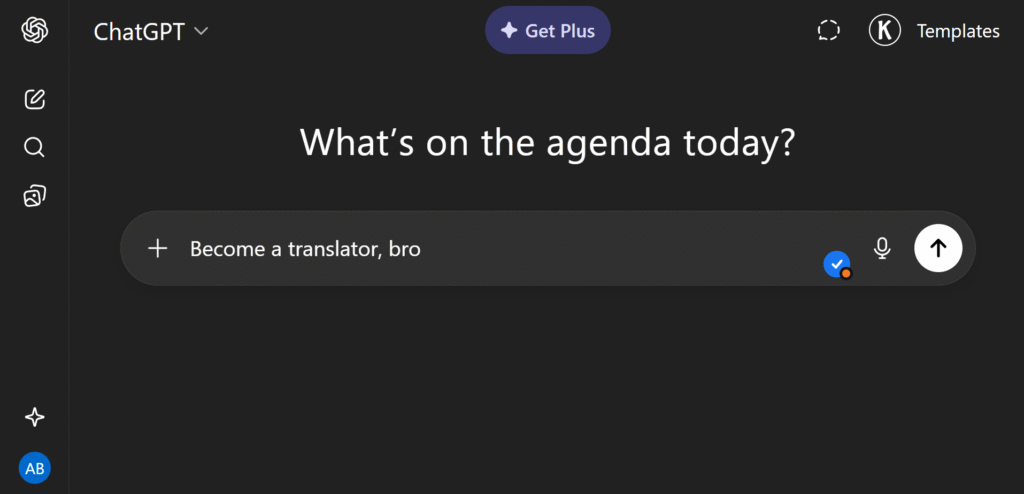
Does ChatGPT work as a translator?
It does, and OpenAI now offers a dedicated page for it. ChatGPT Translate covers 40+ languages, has a “Detect language” option, and promises to translate text “while keeping the original meaning, tone, and intent intact”.
The difference from Google Translate or DeepL is how it works. Those are neural machine translation engines built for one task. ChatGPT is a large language model that can translate, explain, simplify and rewrite in the same conversation. That flexibility is its strength and its weakness, as you will see below. For a direct comparison with DeepL, read the difference between DeepL and ChatGPT.
Which OpenAI models translate in 2026? GPT-5 vs GPT-6
Many guides still talk about GPT-5 for translation. As of November 2026, OpenAI’s model guide recommends a newer lineup, all with multilingual capabilities:
| Model | OpenAI’s description | API price per 1M tokens (input / output) |
|---|---|---|
| GPT-6 Astra | Flagship, most capable model | $10 / $50 |
| GPT-6.1 Sol | Balance of intelligence and cost | $2 / $10 |
| GPT-6 Luna | Cost-sensitive, high-volume workloads | $0.10 / $0.50 |
If your store translations run on GPT-5 through the API, plan a migration: the deprecations page lists the original GPT-5 snapshots (gpt-5, gpt-5-mini, gpt-5-nano) for removal on December 11, 2026. A new model means re-testing prompts and output in every language you sell in.
ChatGPT translation accuracy
ChatGPT’s accuracy depends heavily on how you use it. Because it reads context, longer and clearer input produces better translations. Take the word “hood”. On its own, it could mean a neighborhood, part of a jacket or part of a car. In “It’s cold outside, so I have to put on my hood”, the meaning is obvious, and ChatGPT translates it naturally.
The trade-off: language models are non-deterministic. Ask ChatGPT to translate the same sentence ten times and you can get several valid versions. For a blog post that is fine. For 3,000 product titles that must use identical terms, it is a problem. If you need strict word-for-word correspondence, a classic engine is often more predictable.
Language detection
Automatic detection is convenient, but short or mixed-language text is easy to misread, for example a product name followed by two words in another language. In our experience translating store catalogs, results are clearly better when you state the source language instead of letting the model guess.
Reliability
Ask yourself what you need. If you want the meaning preserved in natural language, ChatGPT is usually reliable. If you need consistent, exact output across thousands of texts, a single model is risky, because nothing checks it before it goes live.

Is ChatGPT a better translator than Google Translate?
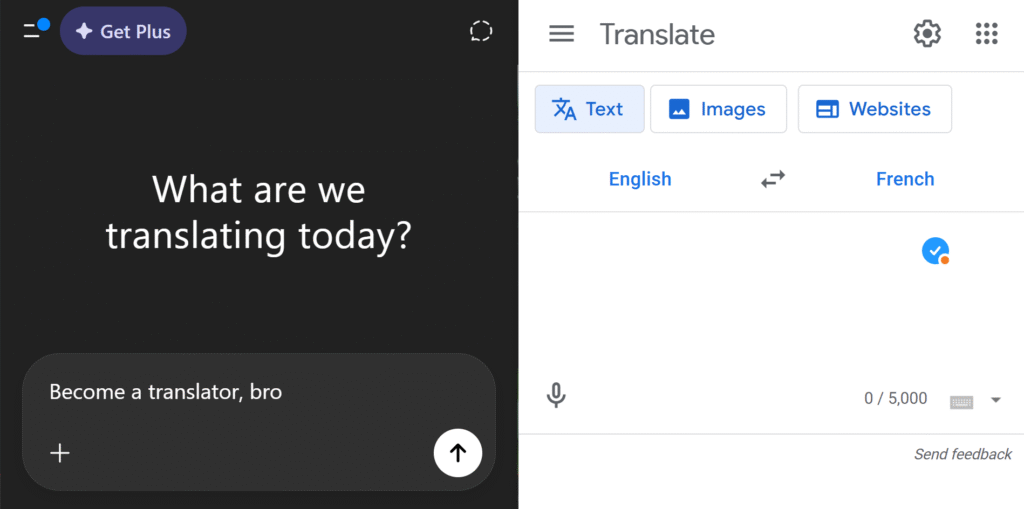
For everyday use, often yes. You can translate a text, then ask for a simpler version, a more formal tone or an explanation of an idiom. Google Translate gives you one answer, fast and predictably. For short, literal strings such as attribute values, that predictability can be the better choice. We compare four tools side by side in Google Translate vs ChatGPT vs DeepL vs Gemini.
Is ChatGPT good for e-commerce translation?
Where it helps:
- marketing copy, emails and social posts that need natural tone;
- adapting descriptions, not only translating them;
- quick drafts and one-off pages in widely spoken languages.
Where it struggles:
- keeping brand and technical terms identical across thousands of products;
- exact specs, sizes and legal wording, where a creative variation is an error;
- scale: the chat window has no connection to your store, and the API needs a pipeline your developers build;
- quality control: if the model gets one translation wrong, nothing tells you.
Language matters too. Large language models generally perform best in widely spoken languages such as English, Spanish, French and German, where they have seen the most text. Check smaller markets more carefully before you publish.
| Use case | Is ChatGPT good enough? |
|---|---|
| Travel, chats, reading foreign pages | Yes |
| Emails and support replies | Yes, with a quick read-through |
| Marketing copy and landing pages | Yes, with native review for key markets |
| Full product catalog in many languages | Not on its own: needs terminology rules, automation and QA |
| Contracts and legal terms | No, not without a qualified human |
We go deeper into the engineering side in Alternative to OpenAI translation for e-commerce.
How good is ChatGPT at translating documents?
Good, when the goal is understanding a document. Never use it unsupervised for contracts, terms and conditions or other legal text. A small change in wording can change the meaning, and with legal content that can create real liability. Have a qualified human review anything binding.
How to use ChatGPT-quality translation safely in a store
The fix for an inconsistent single model is not to drop it, but to stop relying on it alone. Ovesio AI Translation runs OpenAI together with Google Translate, Microsoft Translator, DeepL Pro and Gemini in one workflow. The AI Inspector compares the outputs and keeps the best parts, so when one engine produces a weak result, the others cover it. Ovesio states 95% similarity to human translators at about 1% of agency cost.
- Rules keep terms consistent: ignored translations for brand names, pre-defined translations, replaced words and translation memory.
- Updating a product’s source text updates its translations automatically.
- Plugins for WordPress/WooCommerce, OpenCart, PrestaShop and Magento, plus a REST API and PHP SDK, cover 30+ languages.
Comparing services first? See our pick of the best AI translation services.
Conclusion
ChatGPT is a capable translator for understanding text and for natural-sounding copy. Give it context, name the source language and review anything important. For a full store, its inconsistency is the main risk, so use it as one engine among several with an automatic quality check. Curious how other free tools compare? Read our Meta AI translator review.
Ready to translate your catalog with several engines instead of one? Start your 7-day free trial of Ovesio.