Alternative to OpenAI Translation For E-Commerce

The best alternative to OpenAI for e-commerce translation is not another single model. It is a translation workflow built for product catalogs. OpenAI’s models translate well, but an online store also needs a connection to its platform, enforced terminology, quality checks and automatic updates when product data changes. Ovesio is built around that workflow, and it still uses OpenAI as one of its engines.
Below you will find what OpenAI does well, where a do-it-yourself OpenAI setup runs into trouble at catalog scale, and how a dedicated AI translation platform for e-commerce closes those gaps.
What OpenAI does well for translation
OpenAI’s language models are popular with e-commerce teams for good reasons:
- Fluent output. Translations usually read like natural copy, not word-for-word conversions.
- Context. A model can use the product category or a short brief to pick the right meaning of an ambiguous word.
- Flexibility. The same API can translate, rewrite or adapt tone in one request.
- Developer tooling. Structured Outputs keep responses in a JSON schema you define, and the Batch API processes asynchronous jobs at 50% lower cost with a 24-hour turnaround.
As of November 2026, OpenAI’s model guide recommends GPT-6 Astra as its flagship, GPT-6.1 Sol to balance intelligence and cost, and GPT-6 Luna for cost-sensitive, high-volume workloads. For a developer translating a few hundred items, that is a strong toolkit.
Where a raw OpenAI setup falls short for e-commerce
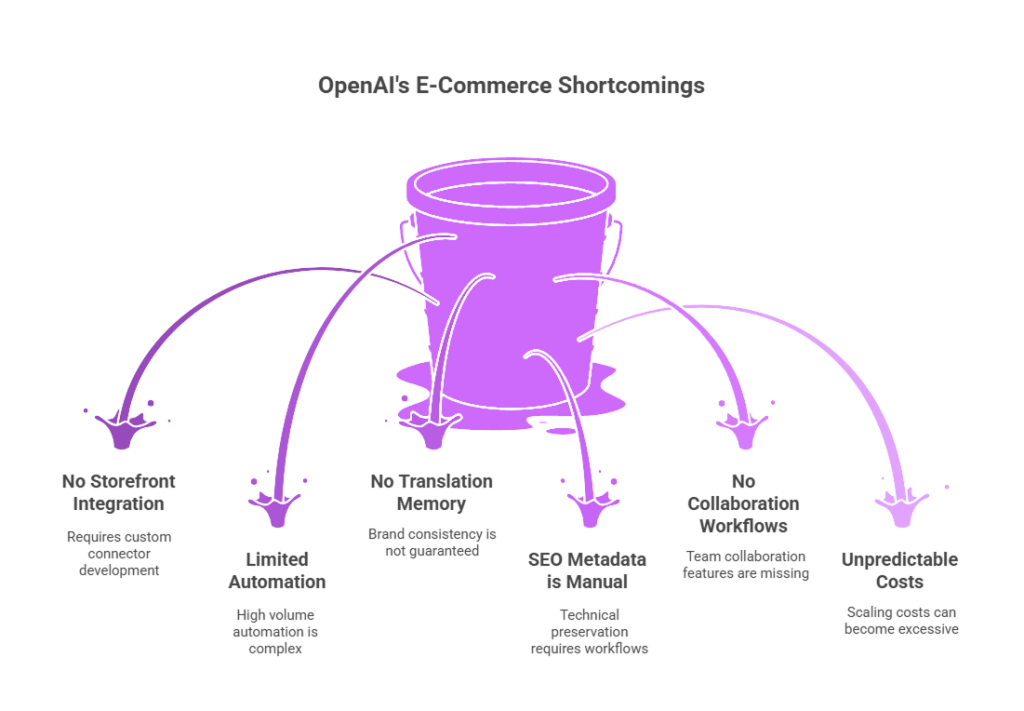
A language model generates text. Running a multilingual store needs much more than generation, and with a raw API you build every missing piece yourself.
1. No connection to your store
OpenAI gives you an endpoint, not a WooCommerce or PrestaShop integration. Reading products, mapping titles, attributes, descriptions and meta fields, then writing translations back to the right language version is your code to write and maintain.
2. Volume, retries and change detection are on you
Translating one description in ChatGPT is trivial. Translating thousands of products, retrying failed requests, avoiding duplicate work and re-translating only what changed is an engineering project.
3. Terminology is not enforced
A model does not remember that your brand name stays in English or that a product line has a fixed name in German. You can add instructions to every prompt, but there is no built-in glossary or translation memory that guarantees the same term every time.
4. One model means one point of failure
LLM output varies between runs. Most results are good, some are not, and with a single model nothing checks the output before it reaches a product page. We cover this in detail in Is ChatGPT good at translation?
5. Models change under you
OpenAI retires models on a schedule. Its deprecations page lists the original GPT-5 snapshots for removal from the API on December 11, 2026. Every switch means re-testing prompts and output quality across all your languages.
6. The real cost is the pipeline
Token prices can be low. The expensive part is the developer time to build, monitor and fix the system around them. If your catalog is small and your team has spare engineering capacity, that trade-off can work. For a growing store, it usually does not.

How Ovesio handles e-commerce translation
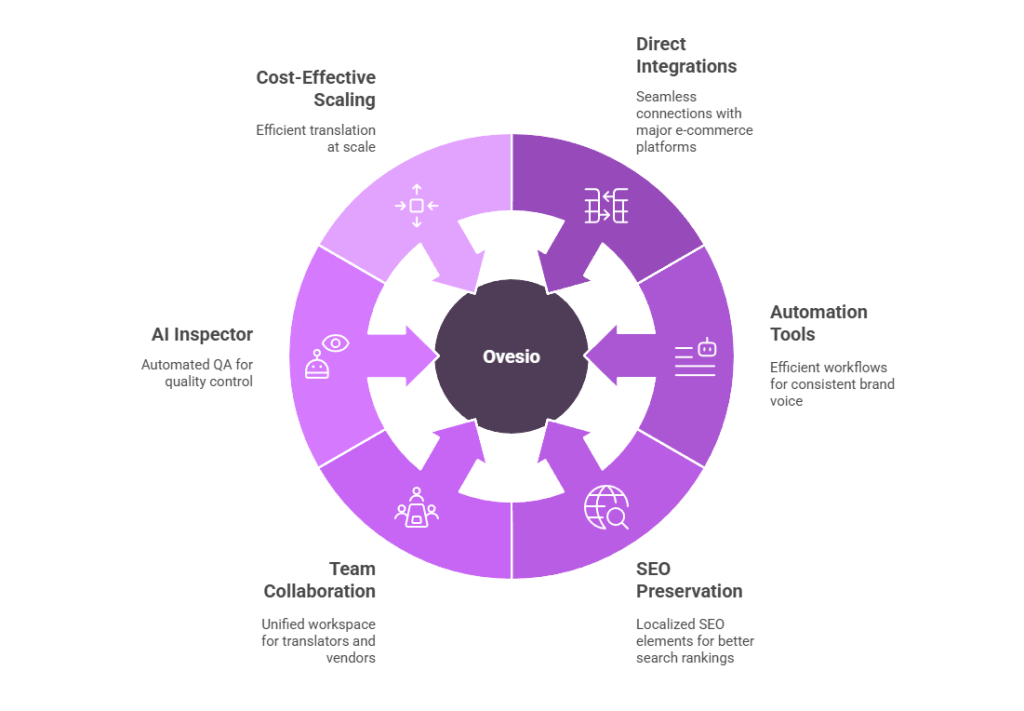
Ovesio is an AI platform for online stores. Its translation module is designed for the jobs a raw API leaves to you:
- Several engines, one result. Ovesio runs Google Translate, Microsoft Translator, DeepL Pro, OpenAI and Gemini in one workflow. The AI Inspector compares the outputs and keeps the best parts, so one weak result does not reach your store. Ovesio states 95% similarity to human translators at about 1% of agency cost.
- Terminology rules. Ignored translations (for brand names), pre-defined translations, replace-word rules, a duplicate translations report, translation feeds and translation memory.
- Automatic updates. When you update the source text, the translations update automatically.
- Reliability built in. Failed requests are retried up to 3 times and charged once, duplicate requests are rejected, and callbacks notify your system when work is done.
- Store integrations. Plugins for WordPress/WooCommerce, OpenCart, PrestaShop and Magento, plus a REST API, PHP SDK and Swagger docs.
- 30+ languages, with product descriptions and SEO meta tags available in the same platform.
You can read how the engines are combined in How Ovesio chooses the best translation and What is the Ovesio AI translation model?
A real example: ComputerShop.eu translated 4,500 products of about 100 words each for €4,521, against an estimated €1,417,500 with human translators.
A typical Ovesio workflow for a busy store
- Install the plugin for your platform or connect through the REST API.
- Choose target languages and the engines you want in the workflow.
- Add your rules: brand names to leave untranslated, fixed translations for key terms.
- Send the catalog. The engines translate, the AI Inspector compares and keeps the best version.
- Translations return to your store. When you edit a product later, its translations follow.
OpenAI API vs Ovesio at a glance
| OpenAI API on its own | Ovesio | |
|---|---|---|
| What it is | General-purpose language models | Translation workflow for online stores |
| Store integration | Built by your developers | Plugins for WooCommerce, OpenCart, PrestaShop, Magento; REST API and PHP SDK |
| Engines | One model per request | Google, Microsoft, DeepL Pro, OpenAI, Gemini, compared by the AI Inspector |
| Terminology | Prompt instructions | Ignored and pre-defined translations, replace words, translation memory |
| Updates and errors | Your own change detection and retry logic | Automatic re-translation on source change; 3 retries charged once |
| Pricing | Per token | Monthly credits, 7-day free trial |
Translation credits start with the Standard plan at €109/month (VAT excluded), which covers about 3.9 million translated characters, or roughly 2,600 products of 1,500 characters. Credit use depends on characters, number of languages and how many engines you run, so the pricing calculator is the quickest way to estimate your catalog. How our credit model works explains the details.
When OpenAI alone is enough
Using OpenAI directly makes sense if you translate a handful of listings, need creative rewrites rather than consistent catalog copy, or are prototyping. Once you manage hundreds or thousands of products in several languages, consistency, automation and quality control matter more than the model itself.
The bottom line
OpenAI is an excellent engine, but an engine is not a translation system. A store that sells across borders needs integrations, terminology control, automatic updates and a second opinion on every translation. Ovesio provides that layer and keeps OpenAI in the mix alongside four other engines.
Want to see the difference on your own products? Try Ovesio AI Translation free for 7 days, no card required.